Saturday, October 22, 2022

Being a Part of Solution

A software development team integrated a scanning tool that provides two lists: one about licenses in use, and another one about supply chain vulnerabilities in all of the components the project relies on. So now we know. We know to drop one component for licenses list to follow an established list of what we can use. And we know we have some vulnerabilities at hand. 

The team thinks of the most natural way of going forward, updating the components to their latest. Being realistic, they scan again, to realize the numbers are changing and while totals are down some, the list is far from empty. List is, in fact, relevant enough that there is a good chance there is not new more relevant vulnerabilities on the list. 

Seeking guidance, team talks to security experts. The sentiment is clear: the team has a problem and the team owns the solution. Experts reiterate the importance of the problem the team is well aware of. But what about the solution? How do we go about solving this? 

I find this same thing - saying fixing bugs is important - is what testers do too. We list all the ways the software can fail, old and new, and at best we help remind that some of the things we are now mentioning are old but their priority is changing. All too much, we work on the problem space, and we shy away from the solutions.

To fix that listing that security scanners provide, you need to make good choices. If you haven't made some bad choices and some better choices, you may not have the necessary information of experimenting into even better choices. Proposals on certainly effective choices are invaluable. 

To address those bugs, the context of use - acting as a proxy for the users to drive most important fixes first - is important. 

Testers are not only information providers, but also information enrichers, and part of teams making the better choices on what we react on. 

Security experts are not just holders of the truth that security is important, but also people who help teams make better choices so that the people spending more time on specializing aren't only specializing on knowing the problem, but also possible solutions.

How we come across matters. Not knowing it all is a reality, but stepping away from sharing that responsibility of doing something about it is necessary. 

Monday, October 17, 2022

Test Automation with Python, an Ecosystem Perspective

Earlier this year, we taught 'Python for Testing' internally at our company. We framed it as four half-day sessions, ensemble testing on everyone's computers to move along on the same exercise keeping everyone along for the ride. We started with installing and configuring vscode and git, python and pytest, and worked our way through tests that look for patterns on logs, to tests on REST apis, to tests on MQTT protocol, to tests on webUI. Each new type of test would be just importing libraries, and we could have continued the list for a very long time. 

Incrementally, very deliberately growing the use of libraries works great when working with new language and new people. We imported pytest for decorating with fixtures and parametrised tests. We imported assertpy for soft assertions. We imported approval tests for push-results-to-file type of comparisons. We imported pytest-allure for prettier reports. We imported requests for REST API calls. We imported paho-mqtt for dealing with mqtt-messages. And finally, we imported selenium to drive webUIs. 

On side of selenium, we built the very same tests importing playwright to driver webUIs, to have concrete conversations on the fact that while there are differences on the exact lines of code you need to write, we can do very much the same things. The only reason we ended up with this is the ten years of one of our pair of teachers on selenium, and the two years from another one of our pair of teachers on playwright.  We taught on selenium. 

You could say, we built our own framework. That is, we introduced the necessary fixtures, agreed on file structures and naming, selected runners and reports - all for the purpose of what we needed to level up our participants. And they learned many things, even the ones with years of experience in the python and testing space. 

Libraries and Frameworks

Library is something you call. Framework is something that sits on top, like a toolset you build within. 

Selenium library on python is for automating the browsers. Like the project web page says, what you do with that power is entirely up to you. 

If you need other selections made on the side of choosing to drive webUIs with selenium (or playwright for that matter), you make those choices. It would be quite safe bet to say that the most popular python framework for selenium is proprietary - each making their own choices. 

But what if you don't want to be making that many choices? You seem to have three general purpose selenium-included test frameworks to consider: 
  • Robot Framework with 7.2k stars on github
  • Helium with 3.1k stars on GitHub (and less active maintainer on new requests) 
  • SeleniumBase with 2.9k stars on GitHub
Making sense of what these include is a whole another story. Robot Framework centers around its own language you can extend with python. Helium and SeleniumBase collect together python ecosystem tools, and use conventions to streamline the getting started perspective. All three are a dependency that set the frame for your other dependencies. If the framework does not include (yet) support for Selenium 4.5, then you won't be using Selenium 4.5. 

Many testers who use frameworks may not be aware what exactly they are using. Especially with Robot Framework. Also, Robot Framework is actively driving people from selenium library to RF into a newer browser library to RF, which includes playwright. 

I made a small comparison of framework features, comparing generally available choices to choices we have ended up with in our proprietary frameworks. 

Frameworks give you features you'd have to build yourself, and centralise and share maintenance of those features and dependencies. They also bind you to those choices. For new people they offer early productivity, sometimes at the expense of later understanding. 

The later understanding, particularly with Robot Framework being popular in Finland may not be visible, and in some circles, has become a common way of recognising people stuck in an automation box we want to get out of. 


Friday, October 14, 2022

WebUI Testing

I don't know about you, but my recent years have seen a lot of systems where users are presented with a webUI. The embedded devices I've tested ship with a built-in web server serving pages. The complex data processing pipelines end up presenting chewed up observations and insights on WebUI. Some are hosted in cloud, others in own server rooms. Even the windows user interfaces turned into webUIs wrapped in some sort of frame that appears less of a browser, but is really just a specializing browser. 

With this in mind, it is no surprise that test automation tooling in this space is both evolving, and source of active buzz. The buzz is often on the new things, introducing something new and shiny. Be it a lovely API, the popularized 'self-healing' or the rebranded 'low-code/no-code' that has been around at least as long as I have been in this industry, there is buzz. 

And where there's buzz, there's sides. I have chosen one side intentionally, which is against Robot Framework and for libraries in the developer team's dominant language. For libraries I am very hard trying to be, as they say, Switzerland - neutral ground. But how could I be neutral ground, as a self-identified Playwright girl, and a member of Selenium Project Leadership Group? I don't really care for any of the tools, but I care for the problems. I want to make sense of the problems and how they are solved. 

In the organization I spend my work days in, we have a variety. We have Robot Framework (with Selenium library). We have Robot Framework (with Playwright library). We have python-pytest with Selenium, and python-pytest with Playwright. We have javascript with Selenium, Playwright and Testcafe, and Cypress. The love and enthusiasm of doing well seems to matter more for success than the libraries, but jury is still out. 

I have spent a significant amount of time trying to make sense on Playwright and Selenium. Cypress, with all the love it is getting in world and my org, seems to come with functional limitations, yet people always test what they can with the tools, and figure out ways of telling that is the most important thing we needed to do, anyway. Playwright and Selenium, that pair is a lot trickier. The discussion seems to center around both testing *real browsers*. Playwright appears to mean a superset-engine browser that real users don't use and would not recognise as real browser. Selenium appears to mean the real browser, the users-use-this browser, with all the hairy versions and stuff that add to the real-world complexity in this space. The one users download, install on their machines and use. 

Understanding this difference on what Playwright and Selenium drive for you isn't making it easy for me.

 I have strong affinity for the idea of risk-based testing, and build the need of it on top of experiences of maintaining cross-browser tests being more work than value. In many of the organizations I have tested in, we choose one browser we automate on, and cover other browsers by agreeing a rotation based on days of the week in testing, time of doing one-off runs of automation half-failing with significant analysis time or agreeing on different people using different browsers while we use our webUI. We have thought we have so few problems cross-browser hearing the customer feedback and analyzing behaviors from telemetry that the investment to cross-browser has just not been worth it. 

With single browser strategy in mind, it matters less if we use that superset-engine browser and automation never sees users-use-this browser. There is the eyes-on-application on our own computers that adds users-use-this browsers, even if not as continuous feedback for each change automation can provide. Risk has appeared both low in likelihood and low in impact when it rarely has hit a customer. We use the infamous words "try Chrome as workaround" while we deliver fix in the next release. 

Reality is that since we don't test across browsers, we believe this is true. It could be true. It could be untrue. The eyes-on sampling has not shown it to be untrue but it is also limited in coverage. Users rarely complain, they just leave if they can. And recognising problems from telemetry is still quite much of a form of art. We don't know if there are bugs we miss on our applications if we rely on superset-engine browsers over users-use-this browsers. 

Browsers of today are not browsers of the future. At least I am picking up a sense of differentiation emerging, where one seems to focus on privacy related features, another being more strict on security, and so on. Even if superset-engine browsers are sufficient for testing of today, are they sufficient for testing in five years with browsers in the stack becoming more and more different from one another. 

Yet that is not all. The answers you end up giving to these questions are going to be different depending on where your team's changes sit on the stack. Your team's contribution to the world of webUIs may be your very own application, and that is where we have large numbers. Each of these application teams need to test their very own application. Your team's contribution may also be on the framework applications are built on. Be it Wordpress or Drupal, or React or Vue, these exists to increase productivity in creating applications and come to an application team as a 3rd party dependency. Your team's contribution could also be in the browser space, providing a platform webUIs run on.  

Picture. Ecosystem Stack

This adds to the trickiness of the question of how do we test for the results we seek. Me on top of that stack with my team of seven will not want to inherit testing of the framework and browser we rely on, when most likely there's bigger teams already testing those and we have enough on our own. But our customers using that webUI we give them, they have no idea if the problem is created by our code, the components we depend on, or the browser we depend on to run this all. They just know they saw a problem with us. That puts us in a more responsible spot, and when the foundation under us leaks and gives us a bad name, we try making new choices of the platform when possible. And we try clear timely reports hoping our tiny voices are heard with that clarify in the game with mammoths. 

For applications teams we have the scale that matters the most for creators of web driver libraries. And with this risk profile and team size, we often need ease, even shortcuts. 

The story is quite different on the platforms the scale of applications rely on. For both browsers and frameworks, it would be great if they lived with users-use-this browsers with versions, variants and all that, and did not shortcut to superset-engine type of an approach where then figuring out something is essentially different becomes a problem for their customers, the webUI development community. The browser and framework vendors won't have access (or means to cover even if they had access) to all our applications, so they sample applications based on some sampling strategy to think their contributions are tested and work. 

We need to test the integrated system not only our own code for our customers. Sitting on top of that stack puts our name on all the problems. But if it costs us extra time to maintain tests cross-browser for users-use-this browser, we may just choose we can't afford to - the cost and the value our customers would get are not in balance. I'm tired of testing for browser and framework problems in the ever-changing world because those organizations wouldn't test their own, but our customers will never understand the complexities of responsibilities across this ecosystem stack. 

We would love if our teams could test what we have coded, and a whole category of cross-browser bugs would be someone else's problem. 

Saturday, October 8, 2022

When do YOU start testing?

This week I was a guest in podcast where we found one another in Polywork. It's a development podcast, and we talked of testing, and the podcaster is an absolute delight to talk to. The end result will air sometime in December. 

One question he asked left me thinking. Paraphrasing, he asked: 

"When do you start testing?" 

I have been thinking about it since. I was thinking about it today listening to TestFlix and the lovely talk by Seema Prabhu and the vivid discussion her talk created on the sense of wall between implementing and testing. And I am still thinking about it. 

The reason I think about this is that there is no single recipe I follow. 

I start testing when I join a project, and will test from whatever I have there at that moment. Joining a new product early on makes the testing I do look very different than joining a legacy product in support mode. But in both cases, I start with learning the product hands-on, asking myself: "why would anyone want to use this?" 

After being established in the project, I find myself usually working with continuous flow of features and changes. It would be easy to say I start testing features as we hear about them, and I test them forever since until they are retired. More concretely, I am often taking part in handoff of the request of that feature, us clarifying it with acceptance criteria that we write down and the product owner reviews to ensure it matches their idea. But not always, because I don't need to work on every feature, as long as we never leave anyone alone carrying the responsibility of (breaking) changes. 

When we figure out the feature, it would be easy to say that as a tester, I am part of architecture discussions. But instead, I have to say I am invited to be part of architecture discussions, but particularly recently I have felt like the learning and ownership that needs to happen in that space benefits from my absence, and my lovely team gives a few sentence summary that makes me feel like I got everything from their 3-hours - well, everything that I needed anyway, in that moment. Sometimes me participating as a tester is great, but not always. 

When the first changes are merged without being integrated with the system, I can start testing them. And sometimes I do. Yet more often, I don't. I look at the unit tests, and engage with questions about them and may not execute anything. And sometimes I don't look at the change when it is first made.

When a series of changes becomes "feature complete", I can start testing it. And sometimes I don't. It's not like I am the only one testing it. I choose to look when it feels like there is a gap I could help identify. But I don't test all the features as they become feature complete, sometimes I test some of the features after they have been released. 

Recently, I have started testing of features we are planning for roadmap next year. I test to make sure we are promising on a level that is realistic and allows us to exceed expectations. As a tester here, I test before a developer has even heard of the features. 

In the past, I have specialized in vendor management and contracts. I learned I can test early, but reporting results of my testing early can double the price of the fixed price contract without adding value. Early conversations of risks are delicate, and contracts have interesting features requiring a very special kind of testing. 

When people ask when do I start testing, they seem to look for a recipe, a process. But my recipe is varied. I seek for the work that serves my team best within the capabilities that I have in that moment of time. I work with the knowledge that testing is too important to be left for only for testers, but that does not mean that testers would not add value in it. But to find value, we need to accept that it is not always located in the same place. 

Instead of asking when do I start testing, I feel like reminding that I never stop. And when you don't stop, you also don't start. 

When do YOU start testing? 


Saturday, September 24, 2022

Empty Calendar Policy

If you seek around for scheduling advice, you will see proposals of scheduling yourself working time. Even if you don't seek for advice but happen to be user of the Microsoft platforms, you may find your inbox filled with that advice. 

"Maybe you should consider scheduling working time for yourself?" 

"You have many meetings in your calendar you have not confirmed"

"You spend N hours a week in meetings and these are the people who appear to be your people"

I have regularly delete these messages, but I have not turned them off. They remind me regularly that you can run your life and your calendar differently. 

My calendar is very close to empty. It does not mean that I would not have things to do, I just like being in control of those things more and let my calendar be in control of me less. 

A lot of the things people send invites for are information sessions, and I put them in my calendar as non-committal tentative reservations. I generally prefer doing information sessions with 2x speed, and the calendar invites I consider less as meetings in calendar, but reminders of cadence of checking out particular categories of information. 

Some things people need me for, and my rule around them is that everything that is supposed to be committed by me, you run by me first. I decide actively what goes into my calendar. 

Towards end of a week, I reflect on what I got done and what I want to do next. And I schedule my goals into the invisible slots without putting them in my calendar. This keeps me flexible to saying yes on things that fit my commitments on various level, and makes it easy for people who I really need to share work with find time in my calendar. 

But this also means that a great way of upsetting me is to decide you want something done, put it in my calendar and not accepting no for an answer claiming that my calendar is empty. 

There is no universal way of how people deal with their scheduling to suit their needs. A safer way is to assume it does not hurt to ping first, ask for consent on scheduling something for a particular timeframe in calendar, and letting people do their own decisions on how "it is only 30 minutes" is sometimes just that, and other times leads into a massive time sink of interrupting type of work that requires attentive time. 

My calendar is free so that I can get things done by limiting work in progress. 


Friday, September 16, 2022

Selenium and Me

In this blog, as usual, I speak for myself, not for the organizations I occasionally represent. I represent so many organizations in general that I find it hard to say which hat, and when. I try to step away when there is a conflict of interests. I am employee of Vaisala, entrepreneur of maaretp. I am board member of Tivia and project leadership committee (PLC) member of Selenium. I'm chairman of Software Testing Finland ry (Ohjelmistotestaus ry). And I'm running TechVoices initiative to help new speakers with a few other lovely people. My work and my hobbies are not the same, but they are synergetic. 

This is all relevant, because I am about to write about Selenium. I'm writing this as me, with all the experiences I have, and not sitting on the powers assigned to me on taking part on decisions about any of these organizations. 

The little old me has now had a month of being welcomed with open hearts and minds into the lovely Selenium community. My paths had crossed with Selenium, first in organizations I work in, then in other communities having love/hate relationship with all things GUI automation including Selenium, and then as keynote speaker at Selenium Conference India. I had come to learn Simon Stewart is a lovely human, and that Manoj Kumar is great to have around when you aspire to learn a lot, and that David Burns cares about all the right things. I had been infected with the knowledge of Pallavi Sharma, reinvigorated with the conversations with Pooja Shah, and watched in admiration the work Puja Jagani is doing with contributing to the project. Now that I hang out in the Selenium community slack, I have discovered how great and welcoming Titus Fortner is, and how much heart and time everyone there puts on things. The people who invited and welcomed me into Selenium PLC, thank you: Marcus Merrell, Bill McGee, Diego Molina and my trustworthy contact, Manoj Kumar. Manoj is the reason I joined, just to get the chance of working more with him more. 

It is fair to say I am here for the people. Not only for the people I now mentioned, or the people in that slack group, a totally intimidating number of 11,133, or the people who already use Selenium, or the 24.6k that star Selenium in GitHub (add a star here!). But the people who get to cross paths with Selenium also in the future.

I joined the project work, even if I am a self-proclaimed 'playwright girl', because I believe the ethos of choosing one to rule them all isn't the best of the industry. Having many means we look around for inspirations, and there is a significant thing in Selenium that should inspire us all: 

It's been around a long time and has never stopped evolving. 18 years is an impressive commitment, that that is just looking back! 

So if you have heard the rumours of "Selenium losing steam", I think you may be working with information that is constantly changing and jury is still out, and evidence where I see it isn't very conclusive.

In this world of fast changes and things evolving, with difficult to grasp messages, I'm adding to the confusion until I reach clarity. I'm starting my modeling of the world from a corner close to me, python. 

I hope to find us on a mutual route of discovering clarity, and would - just as me - welcome you to join whatever we together can cook up with the Selenium open source project. Open means that you can see too much, but also choose what your interests are.  

Thursday, August 18, 2022

The Result Gap - Describe the Invisible

At work, and at a planning meeting. The product owner asks about status of a thing we're working on in the team. It's done, and tested, exclaims the developer. It's done, tested by you but not tested by me, correct the tester. 

This repeats with small word variations all the time. Sometimes it's the eyeroll that says your testing may not be all the testing. Sometimes it is words. Sometimes it is the silence. 

But it is hard to explain to people how it is possible that testing is done but testing is not done. What is this funny business here? 

I started modeling this after one particularly frustrating planning meeting like that. I can explain the gap between testing and testing as the seven functional problems we still needed to correct, and the one completely lost test environment and another completely lost mailsink service that blocked verifying things work. Of the seven functional issues on three minor features one of the issues was that one feature would not work at all in the customer environment, the famous "works on my machine" for the development environment. 

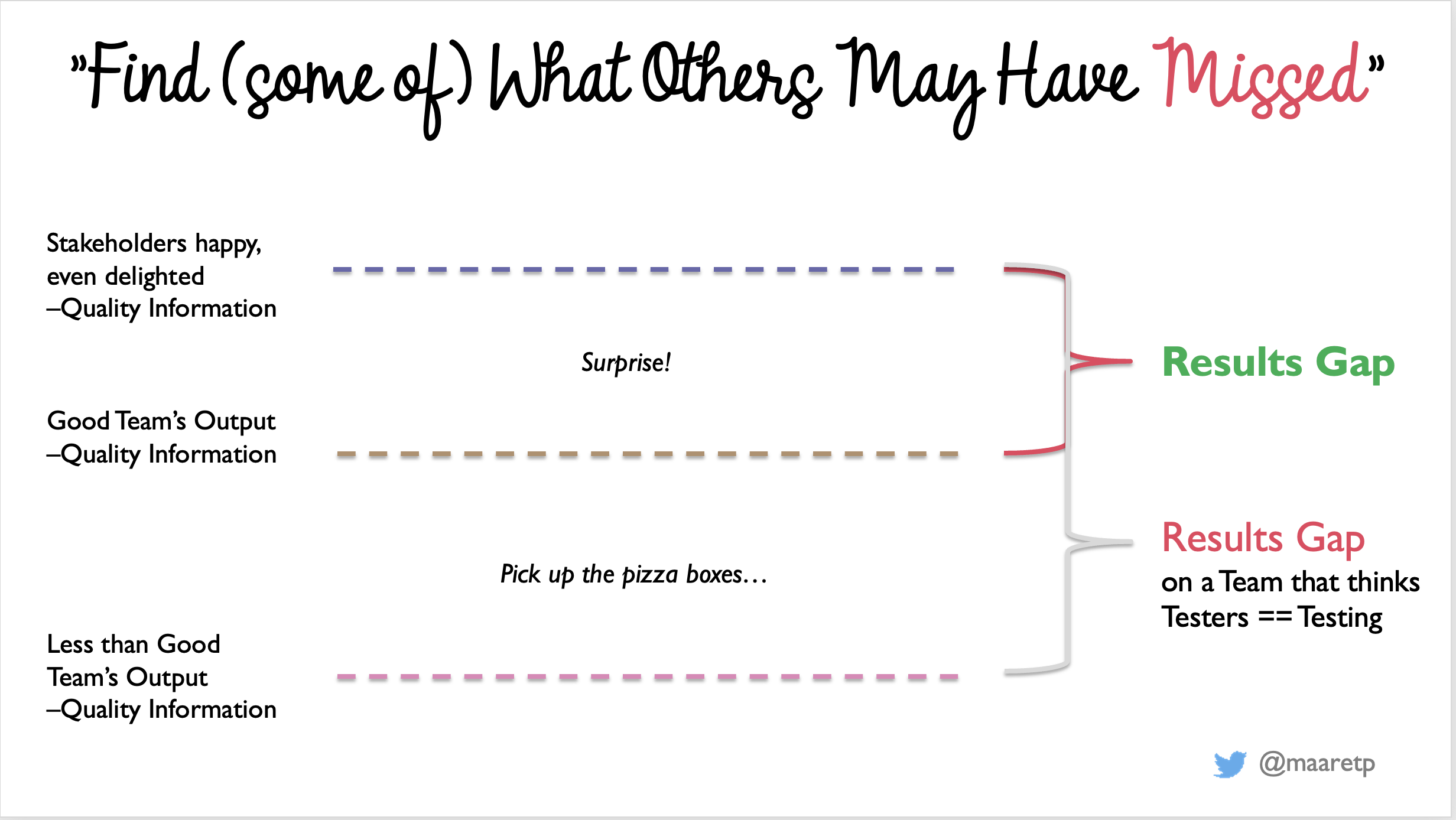
While the conversation of testing being done while testing isn't done is frustrating, describing the difference as the results gap can work. There's the level we really need to have on knowing and working before we bother our customers, and there's the level developers in my great team tend to hit. It is generally pretty good. When they say they tested, they really did. It just left behind a gap. 

I call this type of results gap one of "Surprise!" nature. We are all surprised about how weird things can we miss, and how versatile the ways of software failing can be. We add things with each surprise to our automation tests, yet there seems to be always new ways things can fail. But the surprise nature says these are new ways it fails. 


The top gap is what I expect a developer with a testing emphasis to bring in an agile team. Catch surprises. Make sure they and the team spend enough time and focus to close the results gap. It's a gap we close together over time by learning, but it also may be a gap where learning new things continually is needed. I have yet to meet a team where their best effort to make me useless really made me useless. 

There is another possible meaning for the results gap, and this type of results gap makes me sad. I call this "Pick up the pizza boxes..." results gap. In some teams, the developer with a testing emphasis is tasked to create mechanisms to notice repeating errors. A little like assuming all kids who eat pizza leave the boxes in living room floor and you either automate the reminder making it just right so that kids will react to it and take out the garbage, or you go tell that with your authoritative voice while smiling. Some people and teams think this is what testers are supposed to do - be developers clean up reminding service. 

When working in teams with pizza box results gap, it is hard to ever get to the levels of excellency. You may see all the energy going into managing the bug list of hundreds or thousands that we expect to leave lying around, and half your energy goes into just categorising which piles of garbage we should and should not mention. 

This sad level I see often in teams where management has decided testing is for testers and developers just do unit testing - if even that. The developers are rewarded in fast changes, and fixing those changes is invisible in the ways we account for work. 

What does it look like then in teams where we are minimising the results gap? 

It looks like we are on schedule, or ahead of schedule. 

It looks like we are not inviting developers to continuously do on-call work because their latest changes broke something their automations were not yet attending to. 

It looks like we pair, ensemble, collaborate and learn loads as a team. It look like the developer with testing emphasis is doing exploratory testing documenting with automation, or like I now think of it: all manual testing gets done while preparing the automated testing. It might be that 99% of time is prep, and if prep is too little, your developer with testing emphasis may simplify the world joining the rest of the ream on good team's output level information and no one attends to the results gap on top but the customer. 

Do you know which category of a results gap your team is working on, and how much of a gap there is? Describe the invisible.